BACK TO TOP

viernes, 3 de mayo de 2013

ORDINARY PARENTS DEMAND THEIR CHILDREN TO BE EXTRAORDINARY: THE RAT RACE WAS HIS DOOM

By Gundhramns Hammer
May 3, 2013


Jonnie was asked once about his nationality at school, in a world filled with lots of nationalities in the USA. His answer was:

"I´m half Jewish and half Italian." His teacher was satisfied. 

He was 10 years old at that time and his parents had put him in a special school and pushed him too hard to be the very best in everything because he had scored very high in an culturally bound IQ test.  Ordinary parents demand their children to be extraordinary.

Like a boiling tank with no pressure valve, later this rat race turned out to be his own doom. 

He only lived to be 21, for his body was pushed and put under too much pressure, the weight of learning to be successful exceeded his body´s  capacity in a life that was meant to pace it alone the tracks that were set in the Ice Age.

His family and I were good friends. So, for an Easter Day, I was invited to spend the day with them in Blue Springs (Missouri). We all had a good time and amongst all of the things we talked about there was the question Jonnie had been asked by his teacher.

He repeated word by word to us his story about nationalities at school.

As a joke, I asked Jonnie:

Jon, which part of you is Italian and which is Jewish?

He replied smiling and would point with his right index finger at his left arm as the Jewish part and with the left index finger to his right arm as his Italian part in his body. And he kept on smiling and joking around at the same time that he was playing with his pet hamster on his shoulders.

Jonnie was of Italian descent from Palermo (Sicily) on his mother´s side. His father was the son of a couple who had escaped the rage of Nazi Germany and had settled in the Saint Louis, Missouri.   

In the Summer, Jon would sometimes visit his Italian grandmother who lived in my neighborhood and spend the whole day with her. It was a time for him to relax from his rat race at home and school.  


He would then munch on saltine crackers or feast on a peach pie and celery sticks with peanut butter raisins on them (Fig. 1). He used to call the raisins "ticks". And for a drink, he would have a glass of soda pop, usually orange. 


Figure 1. Celery sticks with peanut butter and raisins. Source: Generation Healthy Kids.


He was a sensitive kid who enjoyed listening to music as he had also learned to play the piano as part of his "genius training", although he was a normal child regarding intelligence.

Once he also got involved into organising a biology club in his own neighbourhood with his friends. They would go about picking up the trash and condoms that teenagers used to leave scattered around in the lonely alleys near his home in the weekends. 

Not everything was rosy coloured for Jon. He once got in trouble with the principal at his school. Jon denounced the principal for a serious fault in the school newspaper, for which he earned the admiration of his schoolmates and the hatred of the man he had dared to touch.

There were occasions in which he would listen to some music at his grandmother´s home. He loved Duran Duran´s Ordinary World. 

One day, Jonnie confessed to his grandmother:

"Grandma, I feel like crying. This music makes me sad and happy at the same time."   


Life went on as usual. When he reached 14 years of age, he was fed up with everything. The pressure was building up deep within Jon until his body would one day burst and give in to cancer.

When he turned 19, out of curiosity, Jon wanted to travel to Germany to see the land of his grandparens on his father´s side. 

So he made a trip to this Alpine country. He stayed there for a couple of weeks visiting with family. 

He came back to the United States a completely different man. He had become a homosexual and returned home ill with a terminal cancer in the bones.

Both things broke his father´s high expectations and his mother was shattered. So was his sister. After the trip,  Jon only lasted a couple of years alive and then he passed away in a hospital.

What happened to Jon in Germany is a secret he took to his tomb.

Jon was a victim of his own family and system, pushing him too hard to reach the stars when he was only an earth-bound kid meant to live life at a relax pace.  

Afterall, man´s biological nature evolved to the beat of Pleistocene times and is not meant to be on a rat race day in and day out. 

Going against Nature´s plans and designs is obviously the equivalent of hitting our heads hard against a wall much to our own regret and failing health in the end.  
 
So, Jon, wherever you are in the Infinite, we all remember you. Here is a tribute to you, one of your favourite songs: Duran Duran´s Ordinary World.


Parents and their fantasies for their children

Jon´s story happens all of the time. A lot of parents make the mistake of living out their own fantasies and filling up their shortcomings in life through their children regardless of the outcomes.

Nowadays, it is a common practice to send children to kindergarten when they are as little as 2 or 3 years old, with the excuse of "making them brighter, smarter and more sociable", something to be proud of and show off as a trophy. 

This happens very frequently because both parents have to work to  make ends meet at the end of the month, for they often live beyond their own means. 

There are also cases when callous mothers get tired of their own children (1-5 years old) and stick them in the day care centres the entire day, so moms can go shopping or getting together with friends. 

Motherhood has also been globalised (Chavkin & Maher, 2010). Children have to stay with grandparents at home whilst their mothers are working hard in foreign lands to send monthly remittances to the whole family to barely survive. That is if the mothers are lucky and do not fall into the hands of human traffickers.

If and when it can be avoided, sending small children to schools at such a early age should be considered a crime, for it is the age at which small children need to be with their own mother.  

There is never a good substitute for a mother. Mothers are culture shapers, for they are in charge of passing on the culture they were born into. Mothers are behind wars and peace. 

"The hand that rocks the craddle rules the world", so goes the saying.

As Chavkin & Maher (2010) point out: "Motherhood is one of the most intimate essential of human connections and therefore of concern to all."

Joseph Chilton Pearce once said, a "Mother is the infant's world, hologram, content for her intent... safe space." She is the solid ground upon which the child builds strength and security to explore the new world around him.

Perhaps in the future if we have any as a species, we will look back and think of these present times as children´s dark ages.

We can only give what we have and were given. What we have is what we give.

So, let us give our very best. We all will be richer for that.


References

Chavkin W. & Maher M.-M. (Eds.) (2010). The Globalization of Motherhood: Deconstructions and Reconstructions of Biology and Care. Routledge Research in Comparative Politics 35. Routledge, Abingdon, Oxon, UK. 271 p.

Ellis B. J. & Bjorklund D. F. (Eds.) (2005). The Social Mind: Evolutionary Psychology and Child Development. The Guilford Press, New York, NY, USA. 540 p.

Meadows S. (1986). Understanding Child Development: Psychological Perspectives in an Interdisciplinary Field Inquiry. Routledge, New York, NY, USA. 250 p.

Robinson M. (2008). Child Development from Birth to Eight: A Journey though the Early Years. Open University Press, Bershire, UK. 241 p.      

 
NB
If translator does not function well, please select the text and paste it  HERE. 

Si el traductor no funciona bien, por favor seleccionad el texto y pegadlo AQUI. 

jueves, 2 de mayo de 2013

LA HORA OSCURA DEL ELEFANTE: SU DOLOR ES NUESTRO DOLOR

Por Gundhramns Hammer
2 de mayo de 2013

 
Fuente: Angelorum


Están al límite. Están al borde del precipicio. Están llorando. Están sufriendo. Su importancia en el ecosistema va más allá de nuestro entendimiento.

Unos pocos amantes de animales luchan por su vida arriesgando su vida. Mientras que otros se burlan y levantan con más ganas el rifle de alto calibre para matar y apuntan a la cabeza y los abaten a tiros para satisfacer su diabólica codicia. 

Esta es la historia del hermano elefante, un prisionero y víctima de la oscuridad del hombre.

Hacemos un omenaje a esta maravillosa criatura con la cual los humanos compartimos su planeta:


Toda búsqueda termina cuando descubrimos que lo que buscábamos siempre había estado en casa. 

Ahora es cuando debemos examinar y reflexionar sobre nuestro breve paso por este planeta. 

Mientras tanto, hagámoslo positivo para todo aquél que se cruza en nuestro camino.
 

Referencias

King B. J. (2013). How Animals Grieve. The University of Chicago Press, Chicago, IL, USA. 208 p.

miércoles, 1 de mayo de 2013

HELADO DE VAINILLA: PIPERONAL, UN INGREDIENTE DE MATA PIOJOS

Por Salvatore Scimino & Henri Cagnengues
1 de mayo de 2013


Fuente: Google imágenes


El verano está de camino. Cuando llegue, la gente se volcará a la calle a asolearse como lagartos, cocinar barbacoas, jugar en el parque, copulaciones furtivas, excursiones y paseos por el monte, acampar y un sin fin de actividades al aire libre.

La estación de calor es una celebración de la liberación aunque sea por unos pocos meses del incómodo invierno y las prendas gruesas de vestir.

Ha llegado la hora de lucir las lorzas de grasa en la cintura, la celulitis y las venas varicosas en la piscina o andar por allí mostrando media teta con un sujerente sujetador o medio testículo del lado derecho asomado en una pierna del shorts para atraer a las moscas.

El cuerpo esbelto o de fideo, si te ha dado por el lado de adelgazar, son piezas de carne muy bien valoradas en estas épocas marcadas por la abundancia de tarados. Y estas piezas de mercancías hay que exhibirlas a toda costa para hinchar el ego.

Posiblemente lo mismo hacía el hombre de la Edad de Hielo. Se quitaba las pieles para estar más cómodo para perseguir a las hembras o a las presas a las que quería clavar.

Nunca la ha tenido tan fácil el humano moderno, al menos el que tiene plata para comprar lo que sus caprichos impuestos por la sociedad de locos le dicten.

Los supermercados están abarrotados de toda clase de mercancías, de cerca y de lejanas tierras. No hay distancia que no se pueda acortar en estos tiempos de gran velocidad y prisa. Prisa para llegar más rápido al cementerio.

Desde que Malcom Purcell McLean inventara y pusiera en marcha el sistema de transporte por medio de contenedores en el puerto de Newark, New Jersey (EU), en 1956, esas cajas metálicas (containers) que se pueden colocar una encima de otra en los grandes cargueros marítimos (Levison, 2006), no hay lugar sobre la Tierra donde no lleguen los productos para los caprichosos atados a mundo de la llamada globalización.

La gente se acumula en las tiendas comprando lo que no necesita y más si hay rebajas, esas reducciones de precio con las cuales cae mucha gente tacaña pensando en que ahorrarán para las golosinas después de llenar el coche hasta el tope.

Hace calor, dice la gente. Y qué mejor manera de irse a la esquina a tragarse una pizza aderezada de quesos plásticos y silicona, beberse algo frío y comerse un cono de helado de vainilla.


Helados con matapiojos

Hacer helados en casa es muy sencillo. Unas frutas, un poco de agua o leche de vaca maltratada, huevos de culo de gallina torturada, azúcar tumba muertos o miel de abejas esclavizadas, y una batidora ruidosa que asusta a los bebés.

Una vez batido el mejunje va para la nevera. Generalmente su textura es dura como piedra y cristalina. Su dureza se puede  controlar un poco con más azúcar o miel que le agreguemos a la mezcla, pero nunca se comparará al helado de fábrica comprado en la tienda de la esquina.

Dado que los consumidores exigen helados como la seda para que no les ofenda su lengua acostumbrada a lo artificial, entonces los tecnólogos de alimentos han encontrado la manera de hacer los helados muy suaves utilizando una gran variedad de ingredientes desde óxidos de titanio y anticongelante hasta compuestos extraídos de algas con mercurio.

Y por esta ventana se cuelan los indeseados químicos artificiales para reducir el costo de su producción en las fábricas.

El consumo de helados es elevado. Más de un billón de helados se venden sólo en los Estados Unidos cada año. Hay sabores para todos los gustos pero el que más se vende es el de vainilla, ese famoso producto extraído de las cápsulas ("vaina") de Vanilla planifolia (Video 1).


                      Video 1. Viaje al centro de la vainilla: la siembra.


La vainilla natural conocida como “vainilla mexicana" o "vainilla Borbón" (de la región de Indico), es una orquídea trepadora nativa de los bosques tropicales del sudeste de Mesoamérica e introducida  en otras regiones tropicales de Asia y Africa (Hernández-Hernández, 2011). Uno de los tesoros biológicos de los Aztecas, los Mayas y los Totonacas.

El problema es que la vainilla natural (Fig. 1) es cara y los fabricantes de productos alimenticios, incluyendo los de helados, son tacaños y siempre andan por allí buscando la manera de “ahorrar dinero”. Ponen sus ganancias antes que la salud del público y te dan gato por liebre. Y tú muy contento consumes lo que te mata. No inmediatamente pero sí poco a poco a largo plazo.


Figura 1. Ilustración de la vainilla (Vanilla planifloia). Fuente: Wikipedia.


Mientras tanto tus quejas, dolores y enfermedades por comer comida chatarra enriquecerán a las multinacionales de la farmacéutica que va mano a mano con la médica.

Así es de que para no gastar tanto en la vainilla natural, pues es un producto de precio elevado e inestable, llegando a valer hasta 480 USD/kg en 2003, costando entre 8 y 12 USD/kg hoy en día y que requiere mucho trabajo para su cosecha, clasificado y preparación (Hernández-Hernández, 2011) para el mercado globalizado, las fábricas de helados echan mano de la vainilla artificial.

¿Cuál? Nada menos que un químico llamado piperonal, un ingrediente también encontrado en los insecticidas para matar piojos.


El piperonal

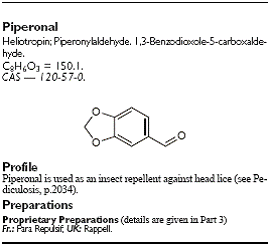
Es un compuesto químico que pertenece al grupo de los aldehídos, relacionado estructuralmente con el benzaldehído y la vainilina. Su nombre sistemático (IUPAC) es 1,3-Benzodioxol-5-carbaldehído. También es conocido como heliotropina y piperonialdehído.

Estructura química del piperonal

Su estructura química es la siguiente (Fig. 2):


Figura 2. Estructura del piperonal. Según Sweetman (2009).


Propiedades

Es una sustancia cristalina incolora, lustrosa, de olor floral, parecido al sabor de la vainilla y cereza naturales. Su punto de fusión es de 37º C, su punto de ebullición es de 263º. Es soluble alcohol, éter, solución de glicol propileno y aceites. Es insoluble en agua y glicerina (Lewis, 2009).

Usos

El piperonal está clasificado como un pesticida (Tabla 1) (Sweetman, 2009). Es un compuesto orgánico utilizado en la manufactura de perfumes, fragancias, repelentes de insectos e insecticidas como agente sinergista. Es ingrediente de insecticidas para matar piojos de la cabeza (pediculosis).


Tabla 1. Clasificación de pesticidas. Según Sweetman (2009). Buscar al piperonal entre “Insect Repellents”.


Toxicidad

El piperonal es una sustancia moderadamente tóxica por las rutas de ingestión e intraperitoneal. Es un irritante de la piel y puede afectar el sistema nervioso central y causar depresión en los humanos (Lewis, 2009).

La dosis letal oral en humanos es de 0.5-5 g/kg, es decir unos 450 gramos para una persona de 70 kg (Wikipedia, 2013).

El Dr. Richard J. Lewis, Sr., es su tratado sobre sustancias industriales peligrosas titulado “Sax´s Dangerous Properties of Industrial Materials, 11th Edition”, en la página 2981 expone lo siguiente del piperonal (Fig. 4):


Figura 4. Extracto del piperonal. Según Lewis (2004).


Entre amigos se entienden

A continuación damos un extracto de un intercambio electrónico de asuntos personales entre los miembros de la oficina de inspección de alimentos de Estados Unidos, es decir del Department of Agriculture Food Safety and Inspection Service intra-agency emails regarding “pink slime”, 2010-2012, part 2, disponible al público bajo la FOIA (Freedom of Information Act), en la cual se revela que el piperonal es un ingrediente de helados y también de insecticida mata piojos:


Ice Cream – One billion gallons of ice cream are consumed by Americans every year. The
most popular flavor? Vanilla. Real vanilla beans are expensive, so to save money, many ice cream makers use a synthetic flavoring called piperonal which is also an ingredient in lice killer.


Camino a convertirse en alien gris

Obviamente que así como va el hombre (Homo insapiens) tarde o temprano se convertirá en un alien gris (Fig. 5) en su propio planeta debido a sus alimentos tóxicos y transgénicos, los cuales le están alterando su ADN.


Fuente: Antonio Rentero Punto Com
                                                             
                                                                          
Fuente: ALGOESTÁCAMBIANDO
                                                                   

Fuente: Mundo Natural
                                                                 
                                               
Fuente: WN Station


Fuente: Learn.Genetics


Fuente: AlienDigest
Figura 5. De cómo el hombre (Homo insapiens) se convirtió en un alien gris.


Damos lástima por lo idiotas que somos nosotros los humanos.

Como en la película “La Muerte Tenía  un Precio”, de Clint Eastwood and Lee Van Cleef, el precio de nuestra transformación o muerte nos saldrá cara. Pero muy cara.

Bueno, al menos con nuestra partida, haremos sitio a otras especies, ya suficiente daño hemos causado en la Tierra.


Un alien gris es capturado y muere

¡Ponti, ayer capturaron a un alienígena!, le dice exaltado Canuto a Pontifacio.

¿Dónde, dónde?, dice Pontifacio muy emocionado y excitado porque es un empedernido cazador de aliens y de ovnis con su cámara.

¡En casa de Pedro!, le contesta Canuto.

¡Ah, no jodas! Ese es Zafiro, el hermano de Pedro, que se ha muerto transformado en alien de tanto comer helado y comida chatarra y carne molida y pollo descongelados”, exclama Pontifacio.

¡Qué decepción! Y yo que me había comprado una cámara  nueva ayer. Bueno, tal vez tenga suerte esta noche en el lago, añadió Pontifacio.

¡Vamos a comernos un helado donde Tapuja! ¿Qué te parece, Ponti?, propone Canuto.

¡Pues venga, vamos!, dice Pontifacio.

Y los dos se alejaron hacia la caseta de la heladera.


Se ve claramente que el hombre (Homo insapiens) nunca aprende las lecciones.


Bueno amigos y amigas, hasta aquí hemos llegado. Esperamos que hayáis aprendido algo Y ¡quien haya dicho que la ciencia es aburrida estaba equivocado! ¿No?


Referencias

Havkin-Frenkel D. & Belanger F. (Eds.) (2011). Handbook of Vanilla Science and Technology. John Wiley & Sons Ltd.-Blackwell Publishing Ltd., Chichester, West Sussex, UK. 339 p.

Hernández-Hernández J. (2011). Mexican Vanilla Production. In: Pp: 3-25, Handbook of Vanilla Science and Technology, Havkin-Frenkel D. & Belanger F. (Eds.) (2011). John Wiley & Sons Ltd.-Blackwell Publishing Ltd., Chichester, West Sussex, UK. 339 p. 

Levison M. (2006). The Box: How the ShippingContainer Made the World Smaller and the World Economy Bigger. Princeton University Press, Princeton, NJ, USA. 376 p.

Lewis R. J. (2004). Sax´s Dangerous Properties of Industrial Materials. 11th Edition. Vol. 1-3. John Wiley & Sons, Inc., Hoboken, NJ, USA. 3734 p.

Odoux E. & Grisoni M. (Eds.) (2011). Vanilla. Medicinal and Aromatic Plants-IndustrialProfiles. Vol. 47. CRC Press, Boca Raton, FL, USA. 368 p.

US Department of Agriculture, Food Safety & Inspection Service (2013). Department ofAgriculture (USDA) intra-agency emails and memoranda regarding “pink slime,”2010-2011 – Part 2. Governmentattic.org, Washington, DC, USA. 2576 p.

Sweetman S. C. (Ed.) (2009). Martindale: The Complete Drug Reference. 36th Edition. Vol. 1-3. Pharmaceutical Press, London, UK. 3694 p. 

Wikipedia (2013). Piperonal. Wikimedia Project. 4 p.


NB
If translator does not function well, please select the text and paste it  HERE. 

Si el traductor no funciona bien, por favor seleccionad el texto y pegadlo AQUI. 


Disclaimer:

The posting of stories, commentaries, reports, documents and links (embedded or otherwise) on this site does not in any way, shape or form, implied or otherwise, necessarily express or suggest endorsement or support of any of such posted material or parts therein. The information herein contained is for educational and/or entertainment purposes only.